Preservation:
the art of staying human, when your world is on fire
Online Exhibit
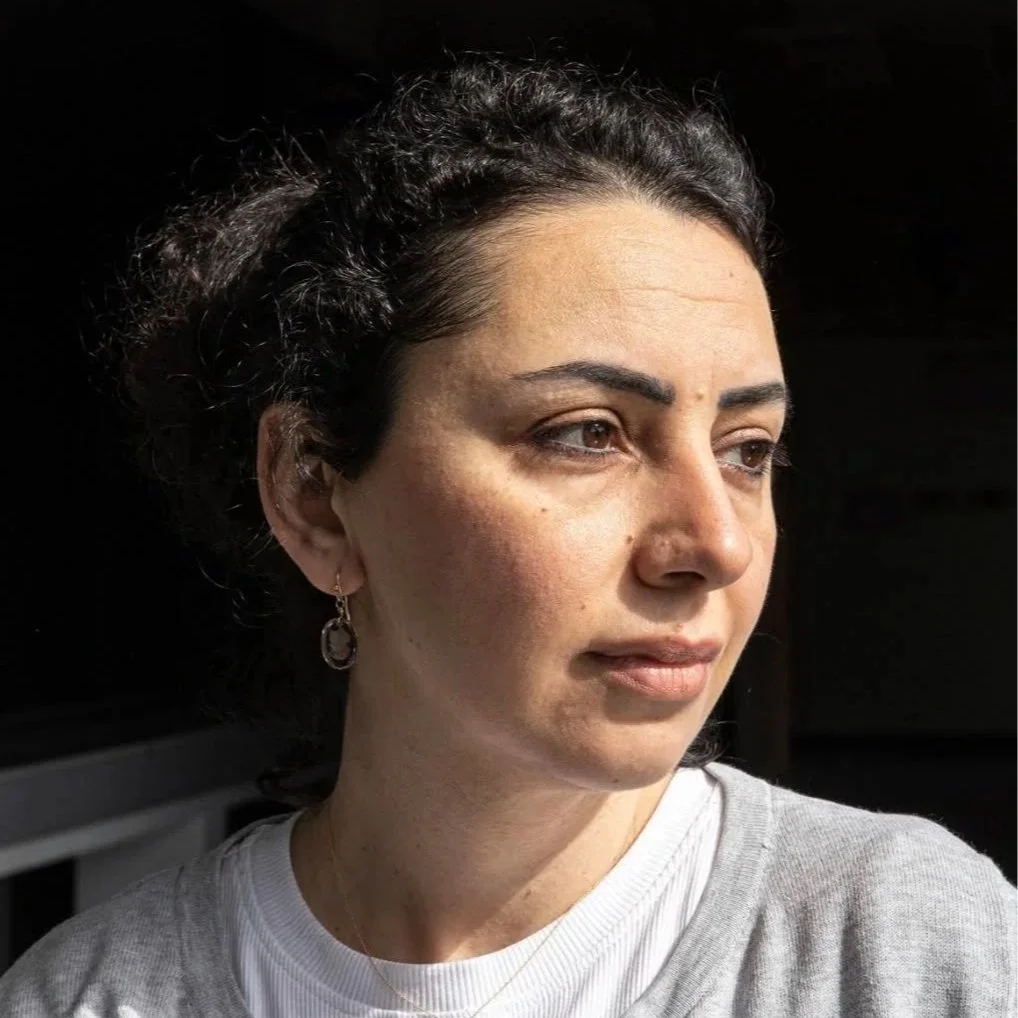
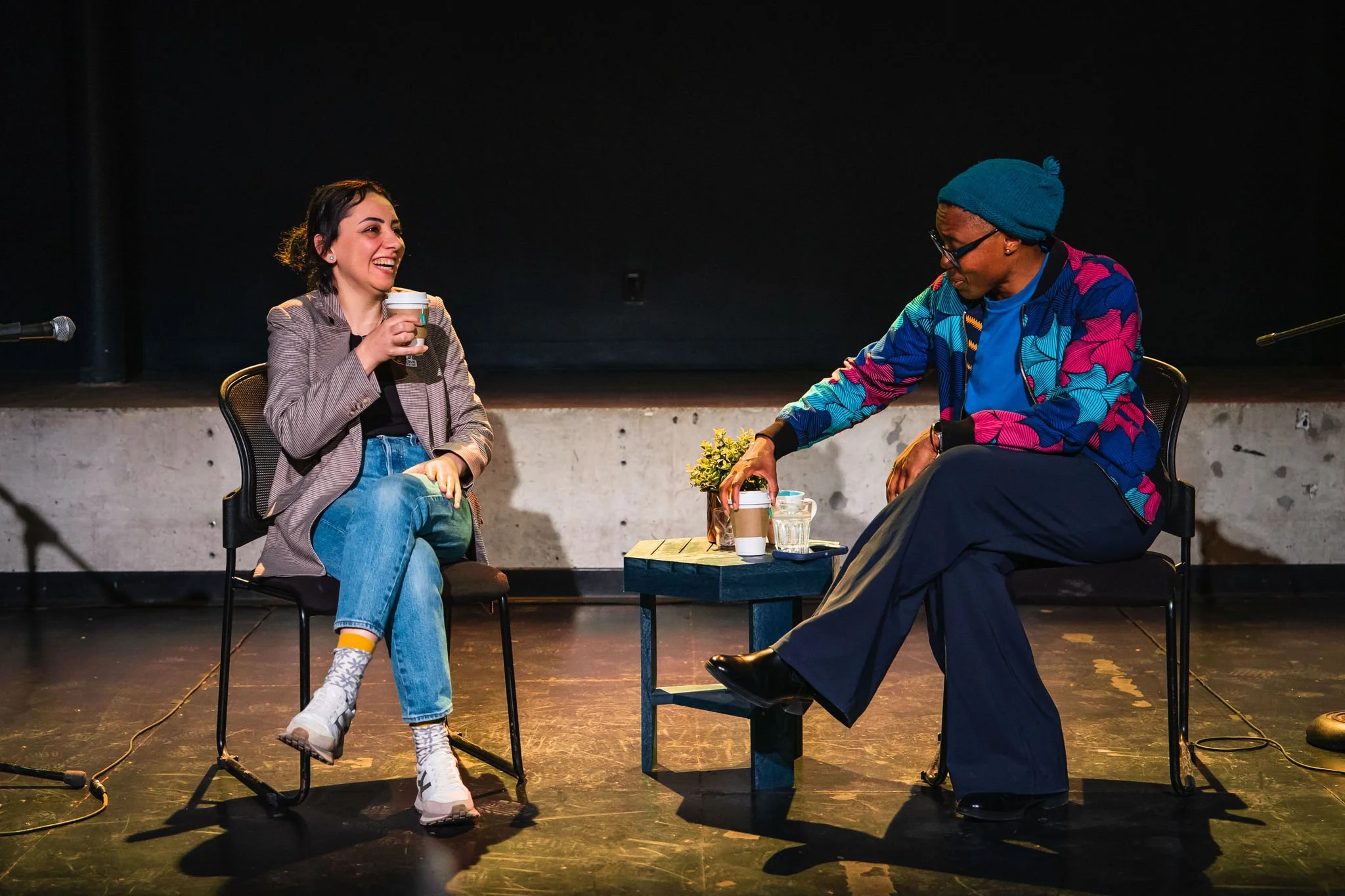
Preservation’s curator, theatre maker Rimah Jabr (pictured left), wrote to four artists located in Gaza, the West Bank, and the diaspora:
“Recently, I have learned that presenting oneself as Palestinian often comes with certain stereotypes and expectations. What does this mean to you? How do you position yourself in relation to this stereotypical context? Is there something you believe deserves attention that someone from outside your environment would not expect?”
This exhibition is their answer.
Preservation is an international project, produced by Canadian theatre company Volcano. Our intention is to preserve cultural voices, insofar as we are able within our limited means, in the face of extreme violence. We do this through artistic commissions for works that are able to cross borders digitally.
Preservation / Palestine is the first iteration of this series.
We know that artists are too often silenced by state violence.
We know their places of work are too often destroyed.
We also know their points of view are essential to humanity.
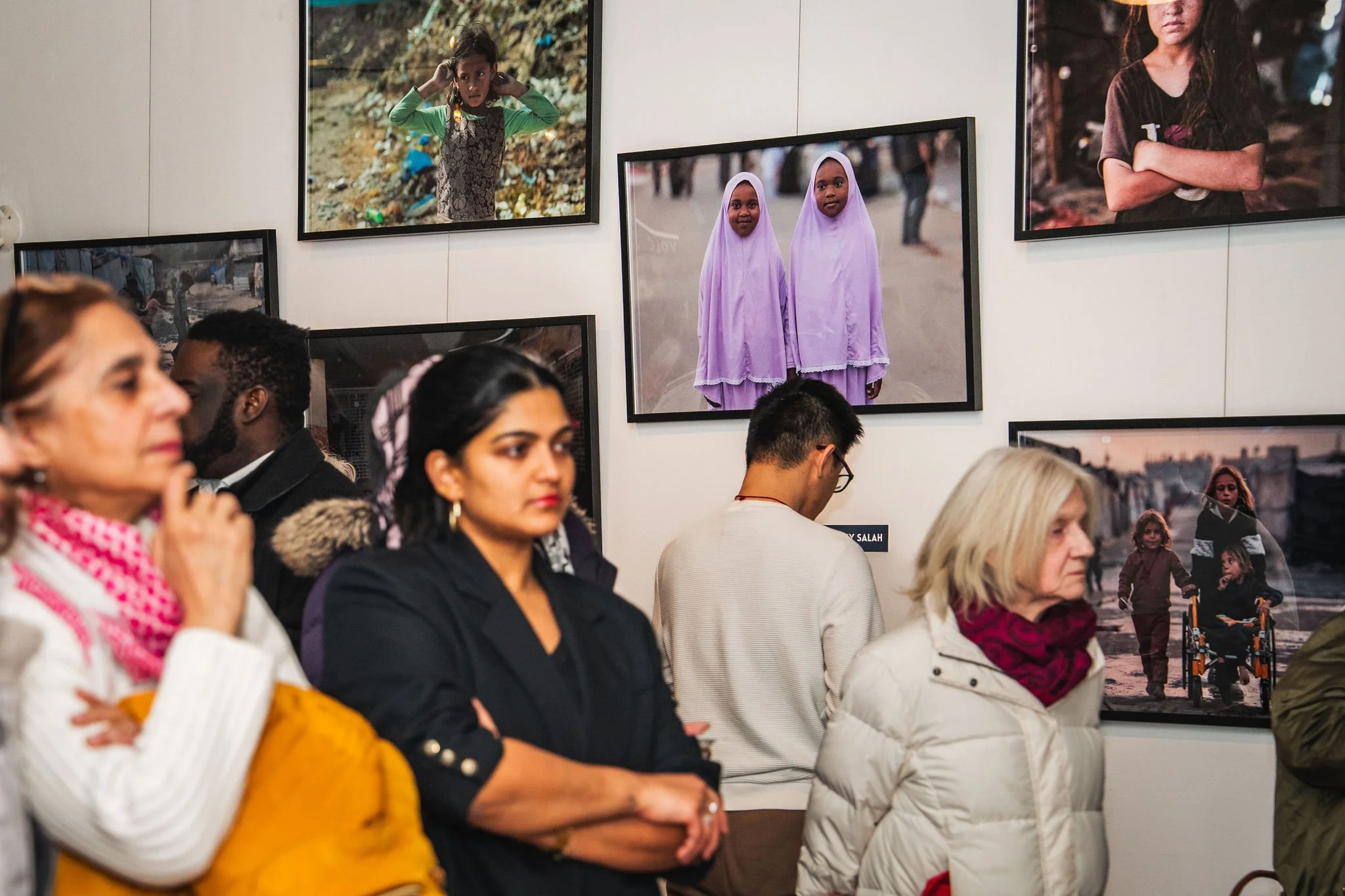
The girls of gaza
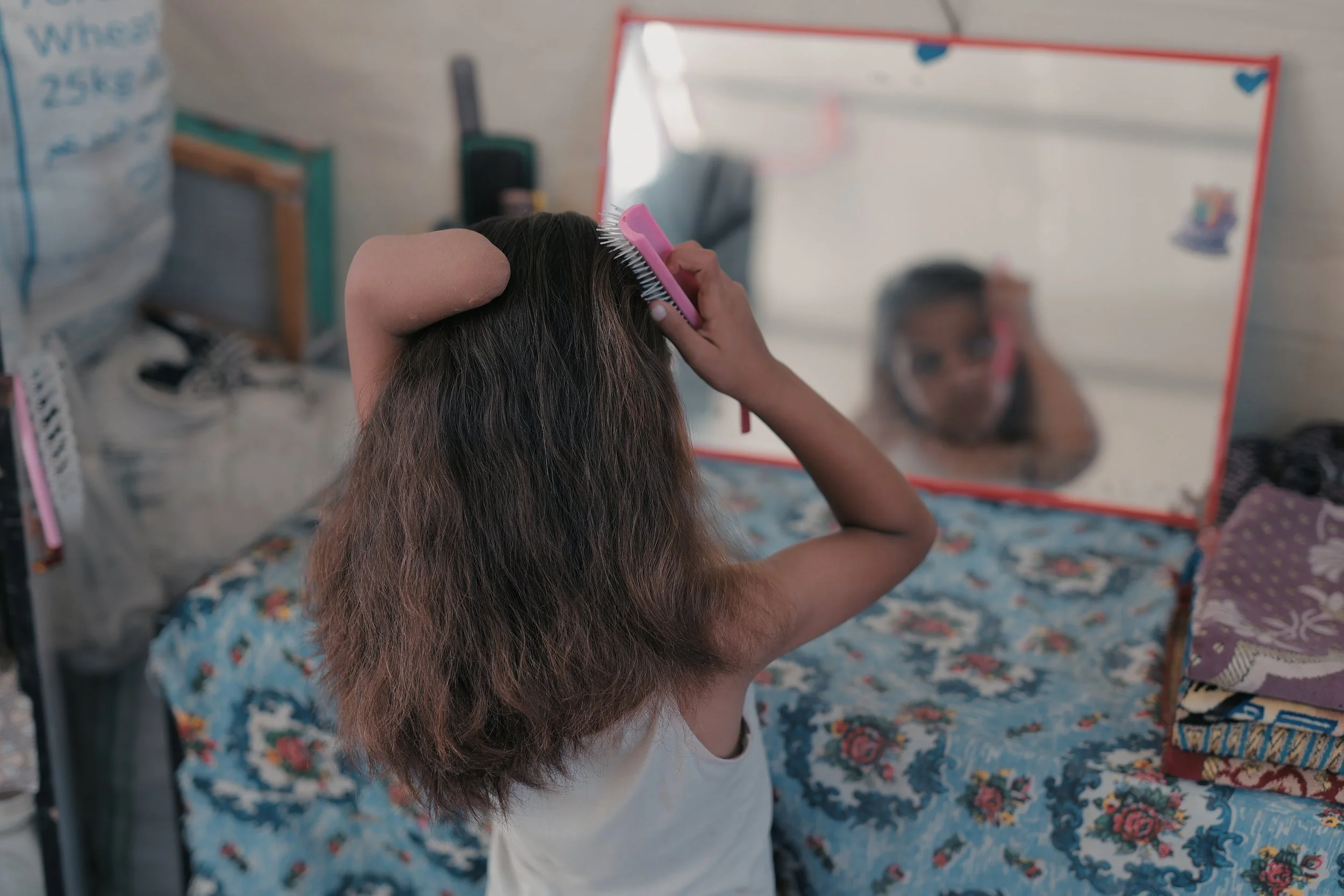
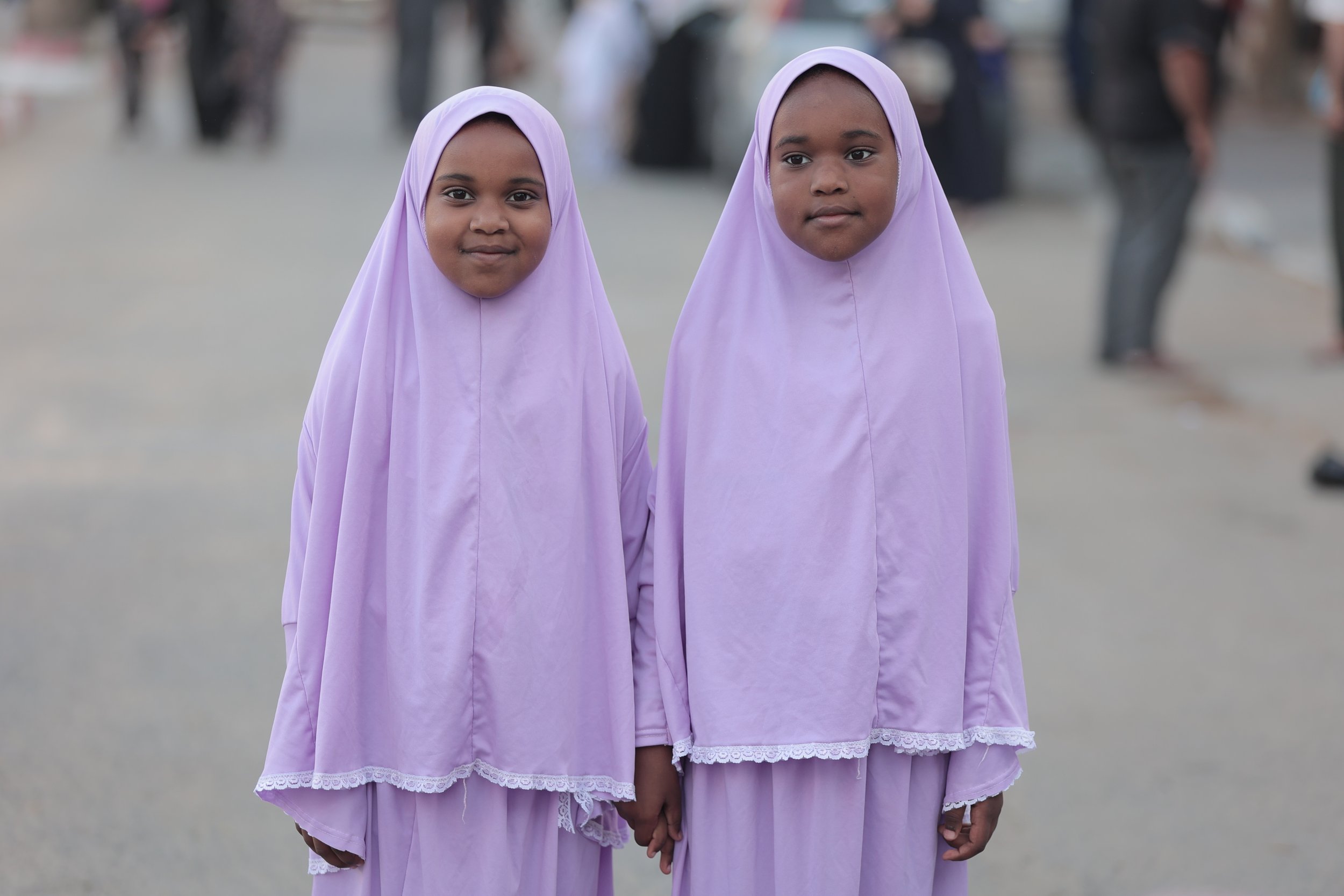
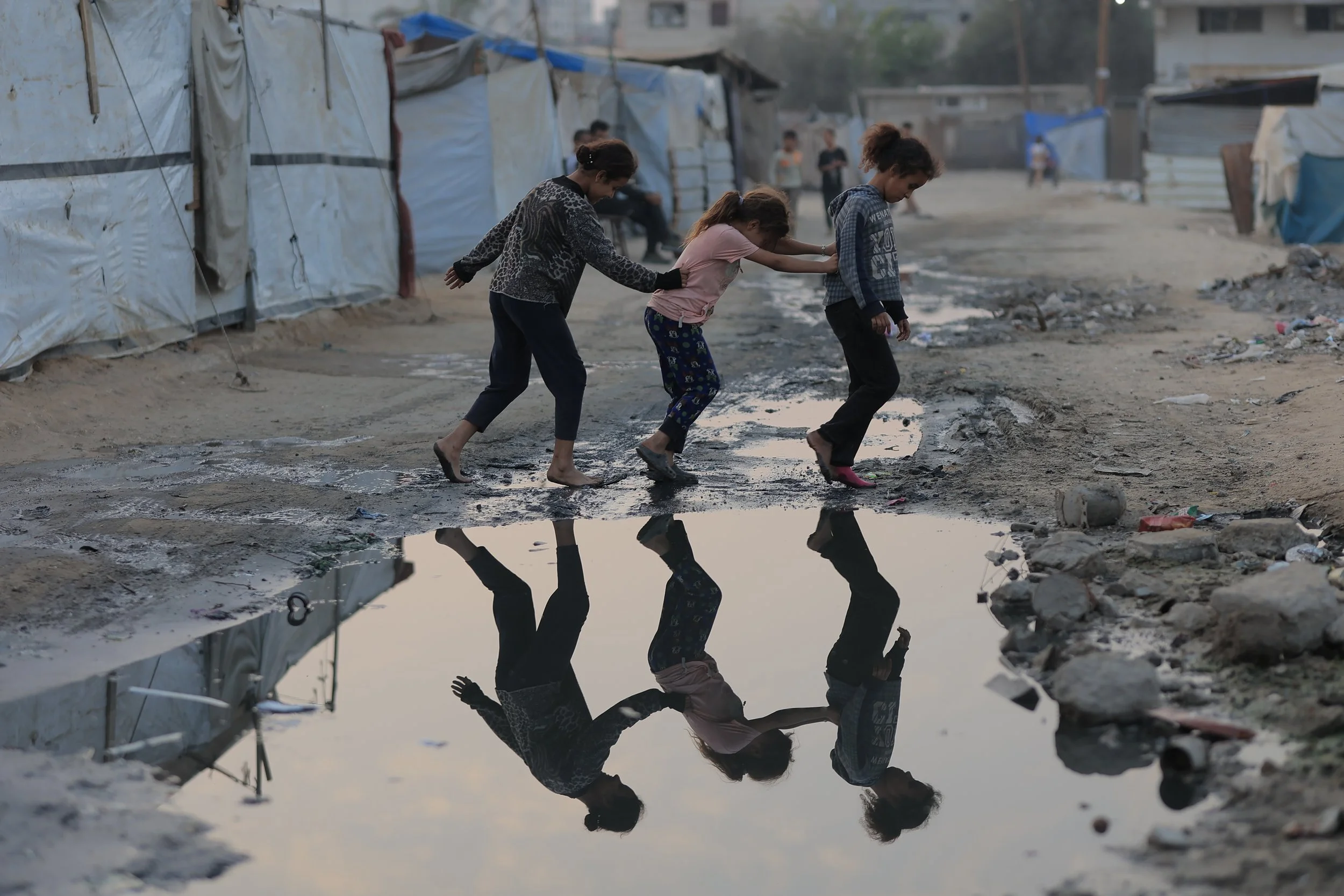
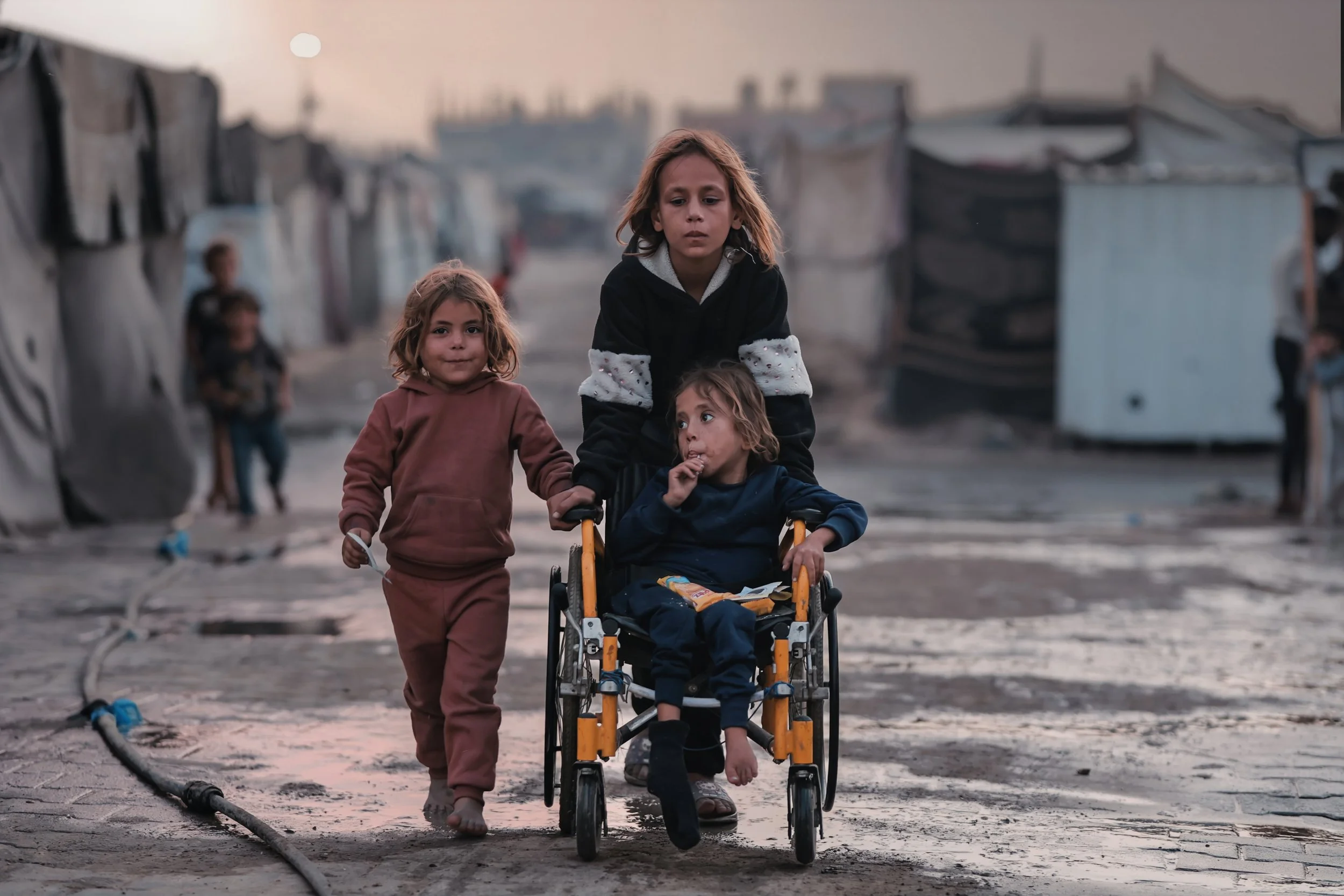
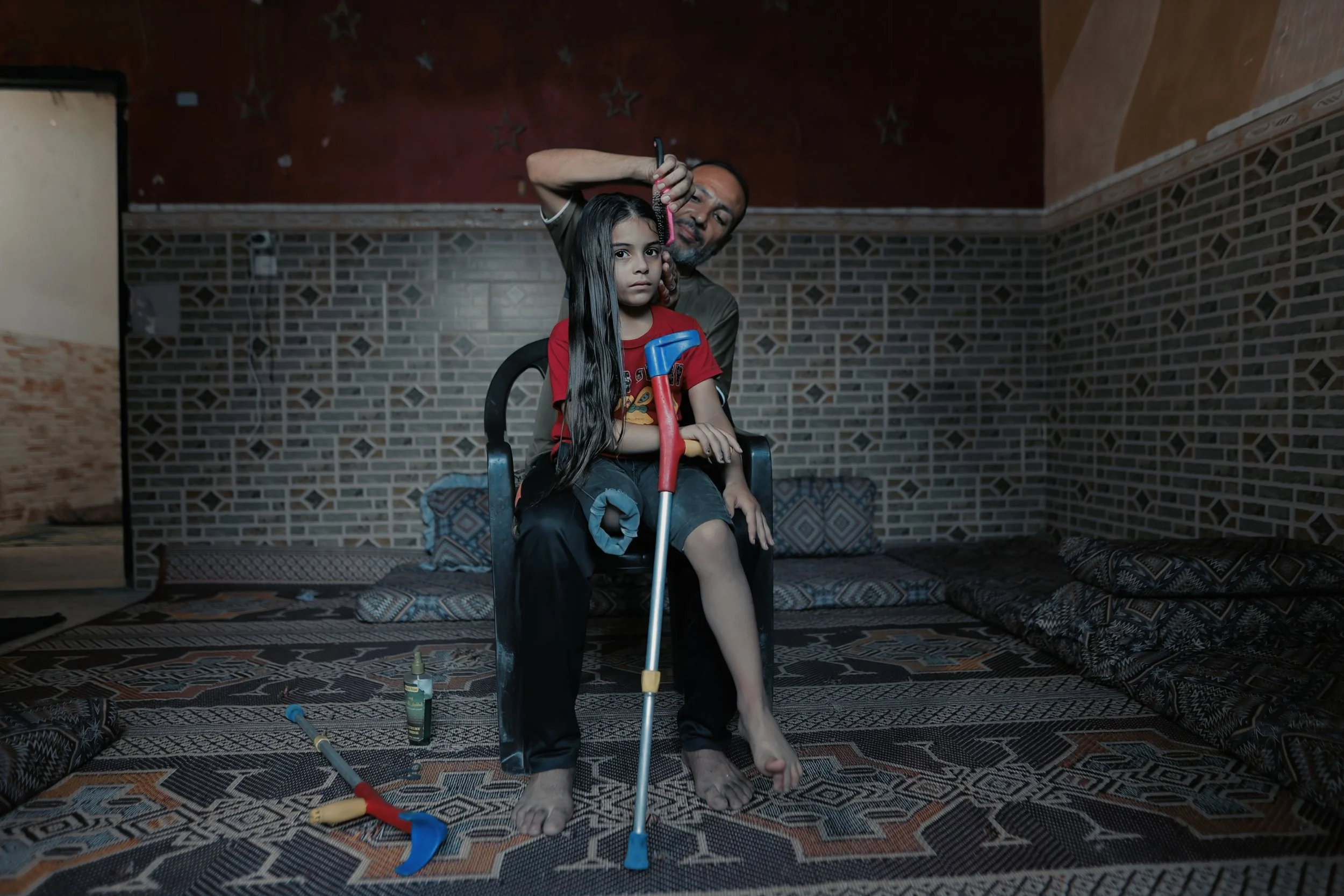
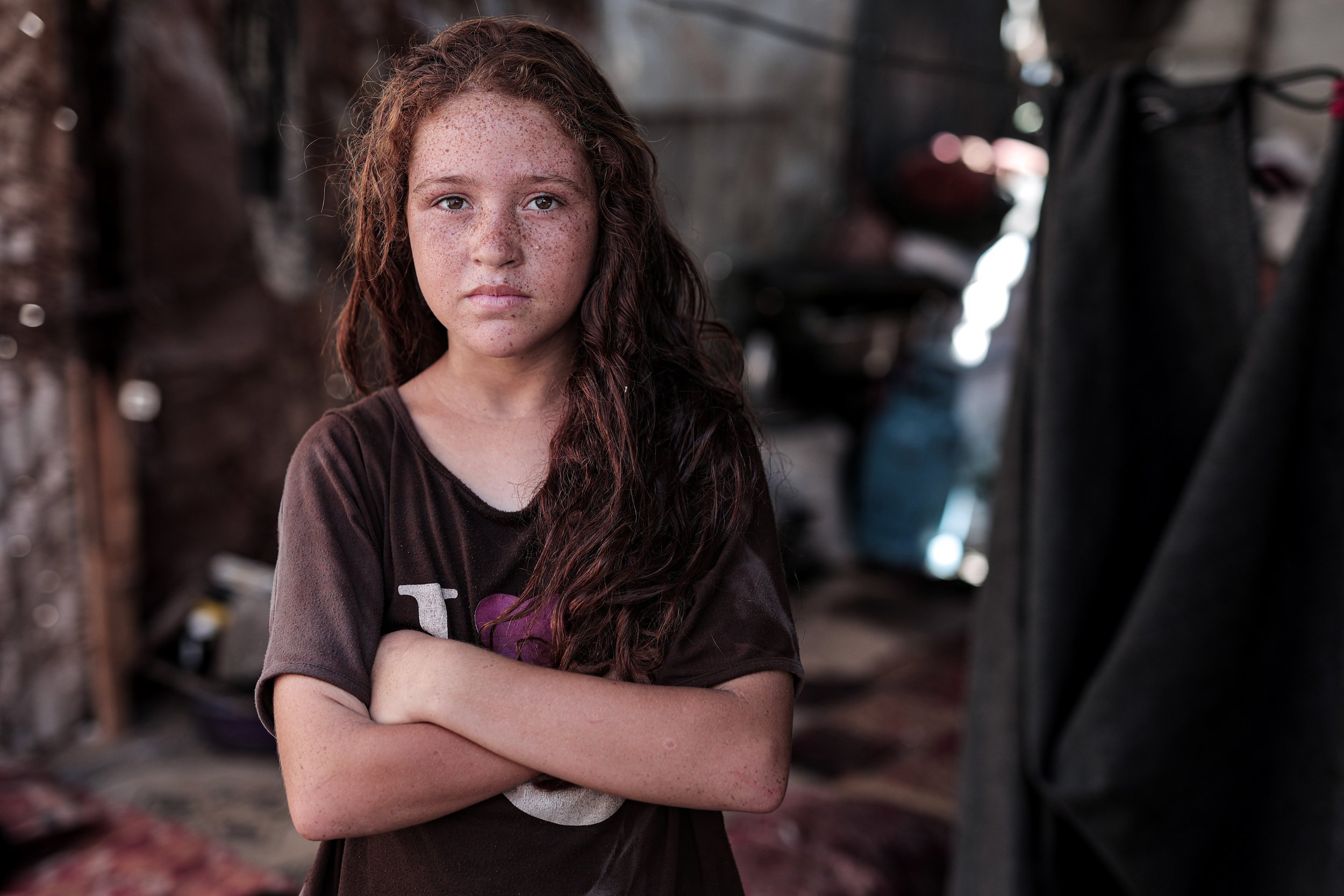
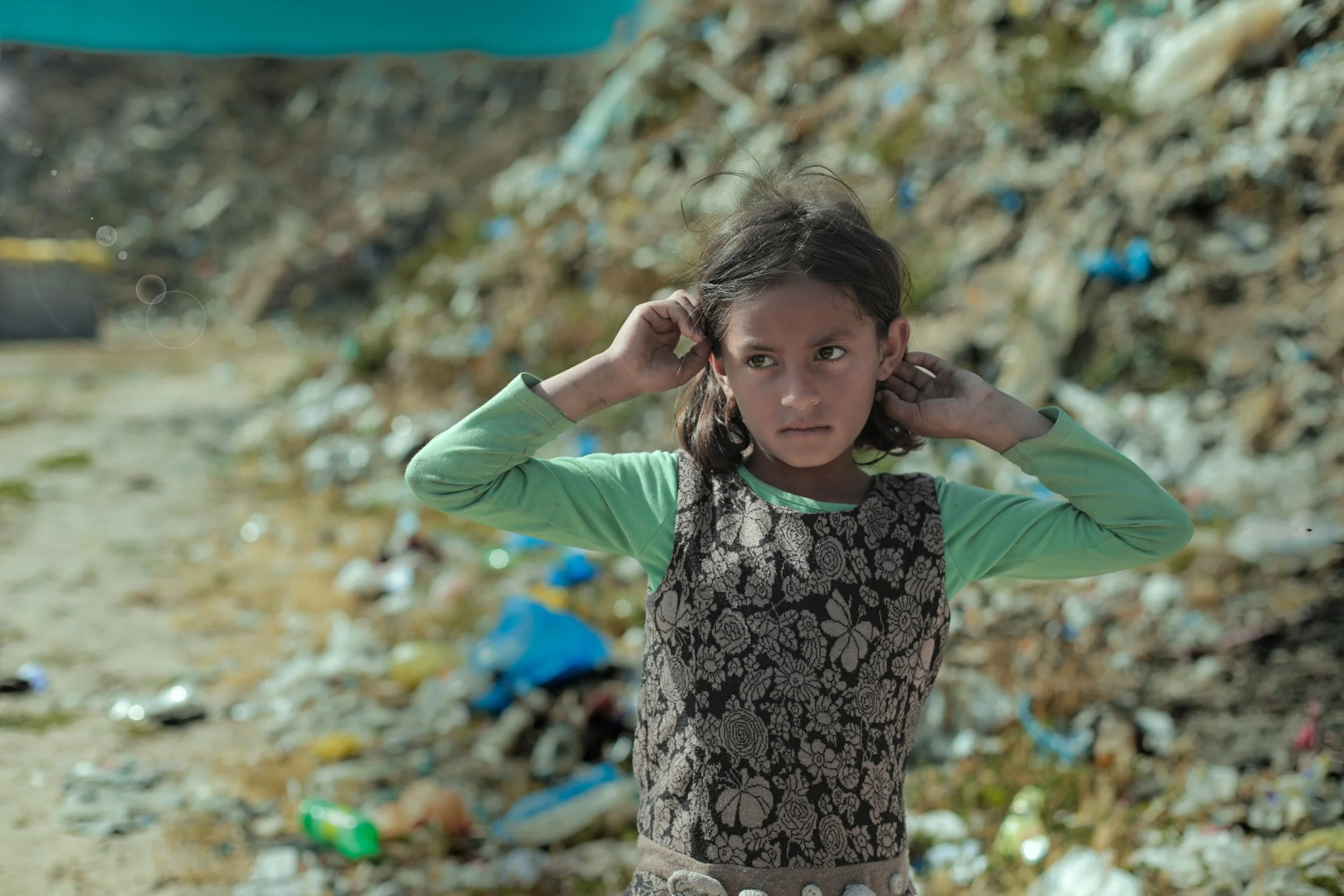
7 photographs by hosny Salah, 2026
Artist Statement:
This collection of photographs is not about documenting a war. It captures moments from the lives of the girls of Gaza.
I chose these moments to say that living is not about the body. It is when hope grows, even in the hardest places. Picture a girl combing her hair in front of a broken mirror, arranging the light around her. See dignity moving forward on a crutch and laughter appearing among the tents. Like stubborn stars that refuse to fade, their eyes still shine.
Gaza is not just a number or a headline. Gaza is the spirit that rises every day, choosing beauty over pain. These photographs are a reminder that the soul stays whole, and real beauty comes from surviving hardship.
Gaza Strip
a film by moaz hosni, 2026
Artist Statement:
The time came when our suffering was supposed to end with death. Instead, we began to suffer from what death had left behind. Now we stand in front of a life distorted in every possible way.
Here in Gaza people are trying to live in a city that is not fit even for ghosts. And yet we carry an instinctive insistence to live – not only because we love life, but because life was created for us, and as human beings, it is our right.
People have abused this grace until the point has been reached where our souls are being taken. If a soul remains, it is left paralyzed in a world that could not bring us a single drop of water when we needed it most.
But even in the middle of noise, shelling and fear, we can still pause for a moment, a short silence, to catch our breath, to look around and feel that we are still alive.
I went to the sea and walked through the streets of this city and I was not surprised by its exhausted people. They are trying to make life out of what is left of life. But what amazes me most are the children, as if the law of breaking and despair was never written for them.
These images are only an attempt to hold on to something of our humanity, so we remember that we were and will remain human beings who love life, and will love life as long as we can.
I move
A film by Marah Haj, 2026 - edited by Jeremy Mimnah
Artist Statement:
I think of distance.
Of the space that separates two points from one another.
You walk on it from one side to arrive to the other,
you stay there and stay and stay and stay.
Then maybe leave.
You catch up on what you have left in other contexts,
but in another language.
You start something new in a different geography
while the motion has been following you
all the way from the start.
What does it truly mean to walk all the land’s borders on foot?
An installation by Shahd Itbakhi
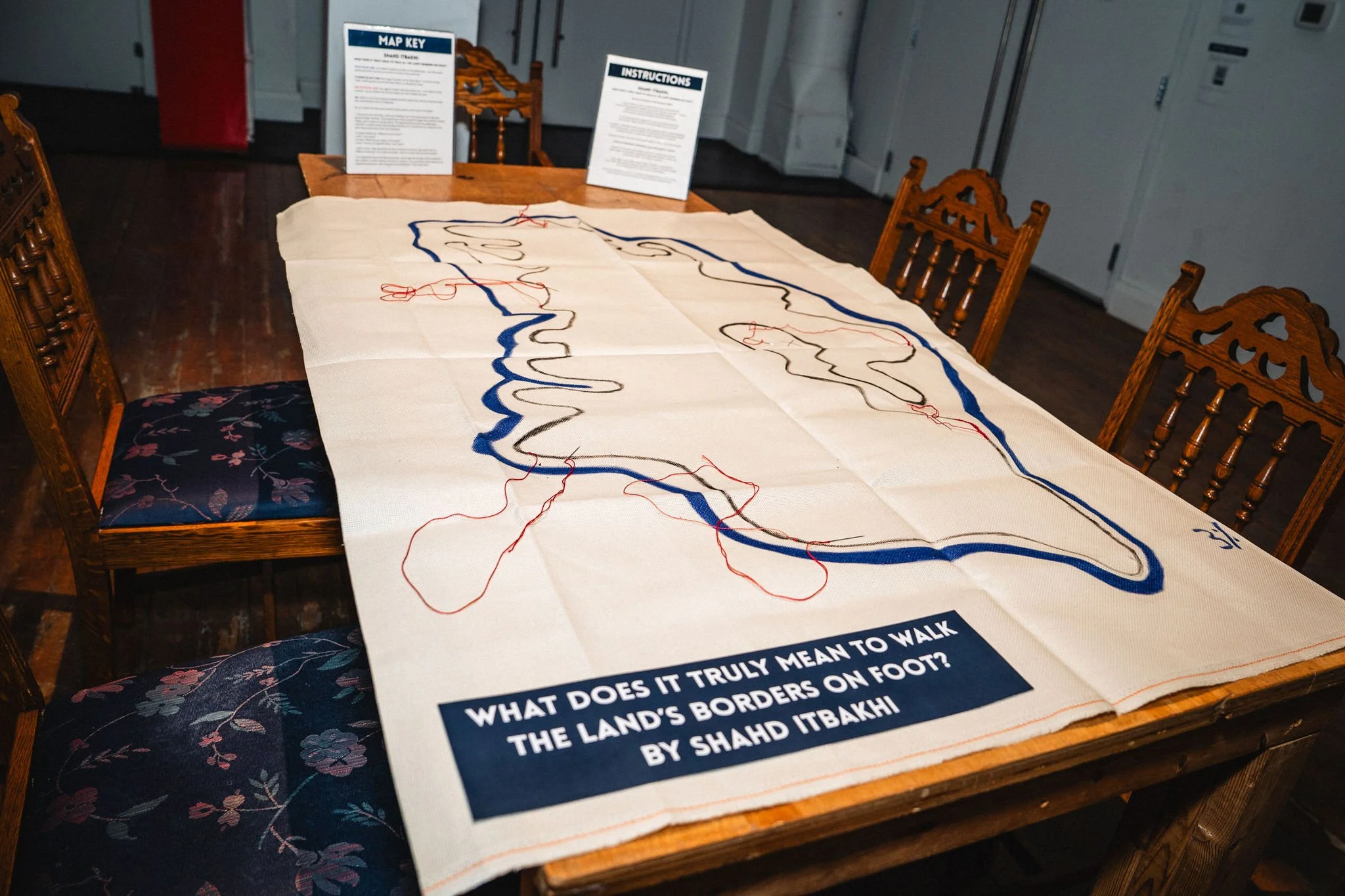
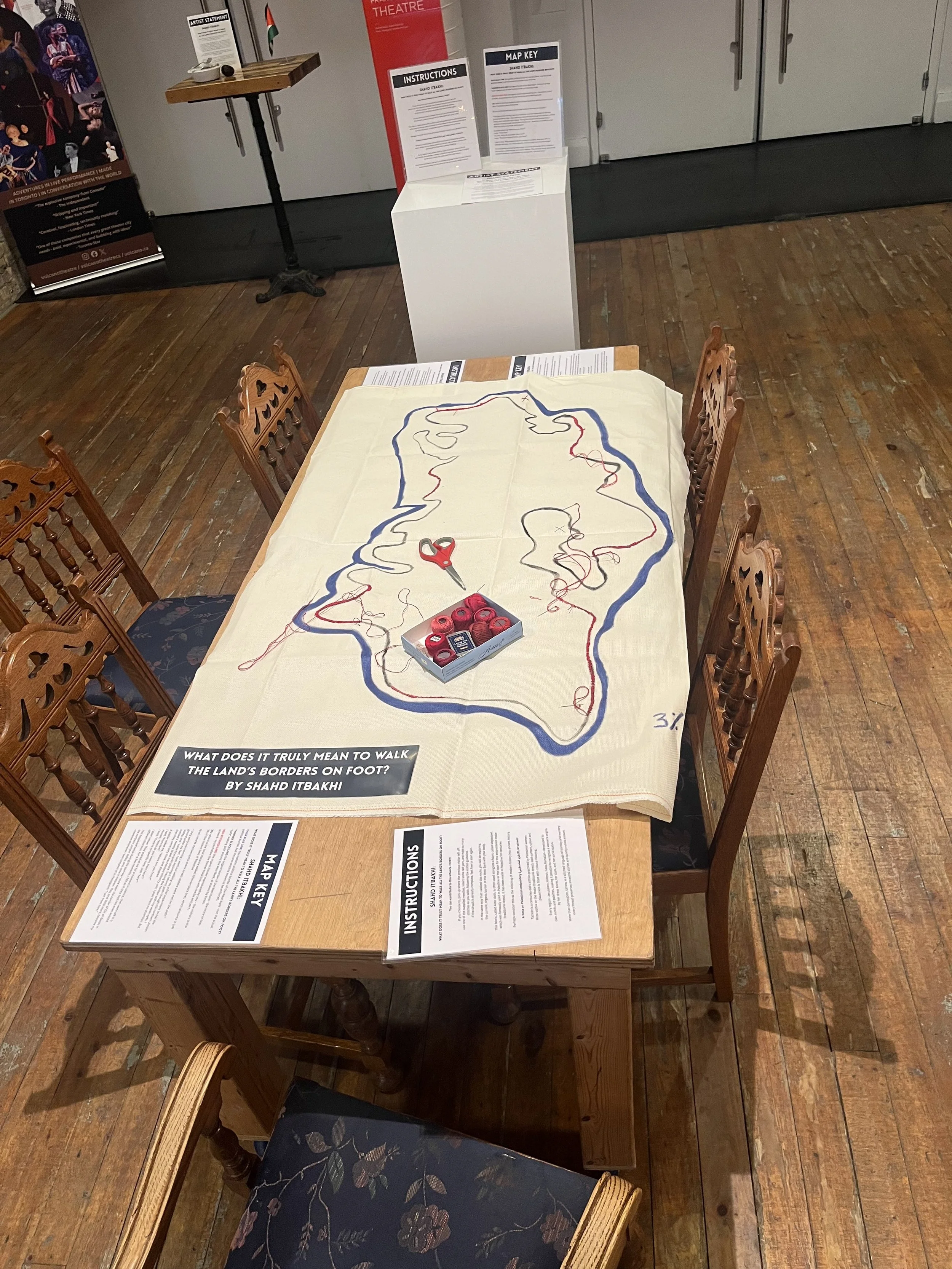
Media: Interactive installation (Fabric and cotton linen, thread, paint)
Year/location created: 2025/2026 in the West Bank, assembled in Toronto
Dimensions/format: 220 x 150 cm
For two months, using the Huawei Health app, I walked the borders of the West Bank. I passed through Palestinian villages that risk disappearing if settlement expansions continue, and through cities with thousands of years of history. My journey did not follow a predetermined political map. Instead, I created what I call an “organic map” I followed the routes shared by local residents, walking only where they themselves were permitted to go.
Perhaps this work sounds more political than artistic, but what is the difference, if art is about lived experience, and lived experience here cannot escape the political?
The political map has shifted many times since the Balfour Declaration in 1917. With each political event, the map shrinks further—this one is even smaller. I asked local farmers and residents how far I could walk, and they pointed out specific areas we could not cross. The red thread being sewn into this fabric is the route that was shown to me.
This map is organic. It traces a spirit that challenges the political. It stands in opposition to the many failed peace accords and shrinking political maps, offering a living, human alternative.
Map Key:
THICK BLUE LINE: the realistic political border of the West Bank - not the actual political border, but the one which is known to be enforced.
THINNER BLACK LINE: the organic border of the West Bank - the more-or-less “safe” walking path around the West Bank, as shared by locals.
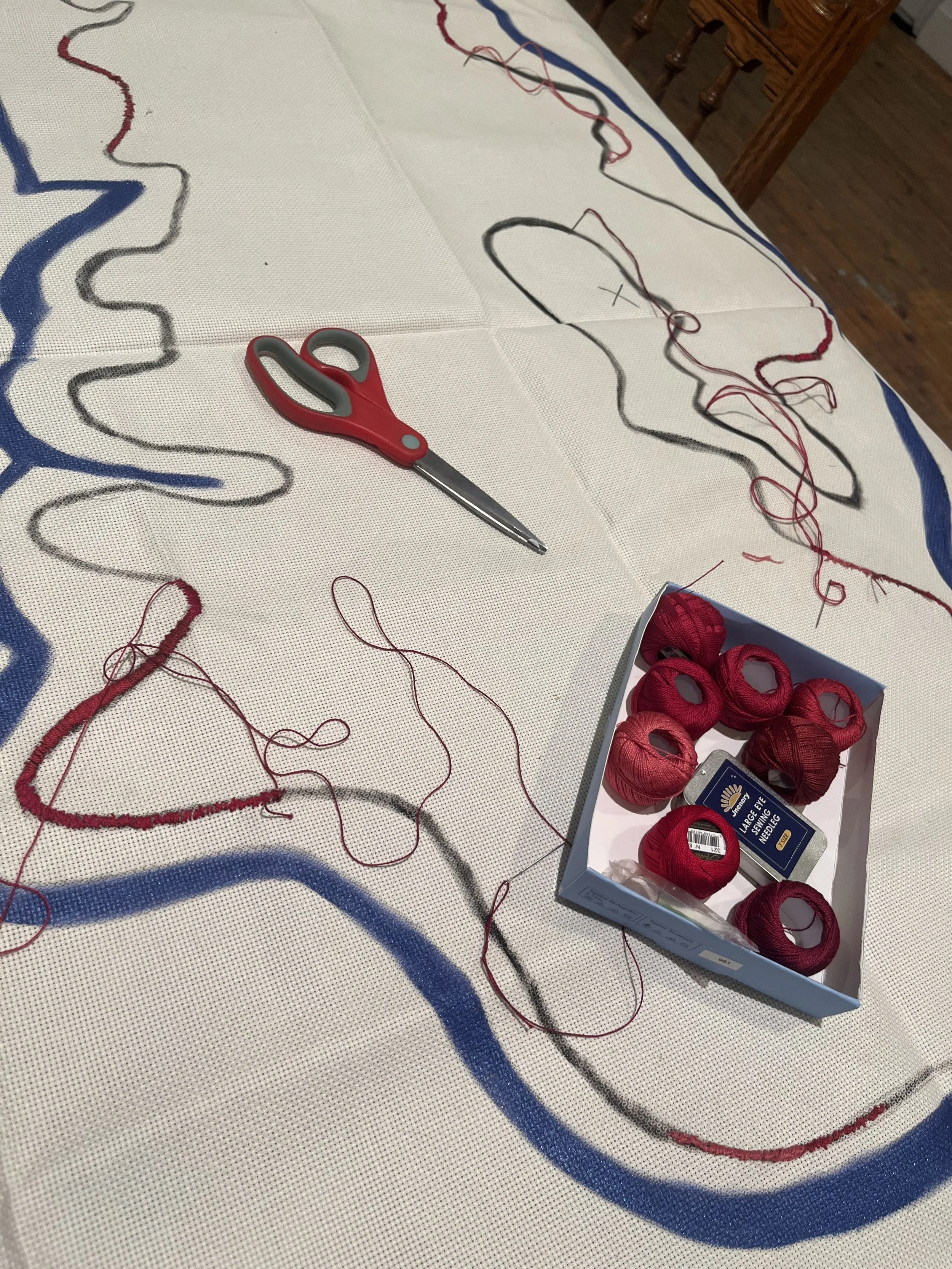
RED STITCHED LINE: the organic border reproduced by you – the visitors to the artwork - as you follow the thinner black line with needle and yarn.
3%: refers to the total distance walked (thinner black line), which amounts to just 3% of the historic land of Palestine
X: an X marks the two spots where Israeli soldiers were met on the path*
*Very early one morning, I went out walking—as a first experiment to feel the ground under my feet. I was exploring a natural path through the northern Jordan Valley, and I came to a quiet place. Tracing the horizon with my weak eyes, I noticed a nearby Israeli mechanized infantry unit. I paid them no attention. But then they came very close, and stopped.
A soldier asked me, “Where are you from?”
I said, “From here.”
He said, “What do you mean, from here?”
I said, “There is no specific here. Just ‘here.’”
I didn’t move. They stared at me for a moment in silence, then went off in a different direction. For a few moments, I felt as if they had not even existed.
This happened twice during the journey—once near the border of Ein al-Beida in the northern Jordan Valley, and once in Hebron. This, and little more, became my response whenever I was stopped at a checkpoint: “I am from here.”
These are the instructions that accompanied the live installation:
You can contribute to this artwork. HOW?!
If you choose to, pick up where the previous visitor left off: use one of the supplied needles, insert some red yarn, and make as many stitches as you wish, following the dotted guideline. If the circuit is already complete, feel free to start again.
In the same way that I walked this route, you will be exploring the current, organic border of the West Bank with your body.
This fabric, called Aida cloth, is often used alongside a fabric called Majdalawi, which was famously used in Palestine as the base for the embroidered thobe (traditional dress). It has been made in Palestine for centuries.
Perhaps consider this as the stitching of modern history into ancient history.
A Note on Palestinian embroidery (التطريز الفلسطيني), or tatreez:
Tatreez is a centuries-old tradition practiced by Palestinian women. Most visible on the thobe (traditional dress), each pattern, colour, and placement is filled with cultural meaning.
Every region—Jerusalem, Hebron, Gaza, Ramallah—developed its own motifs and palettes, making it possible to recognize a woman’s origins by her dress alone, her class, and her social status.
More than decoration, tatreez is a stitched language of identity and memory: every thread preserves ancestral stories and quietly resists erasure.